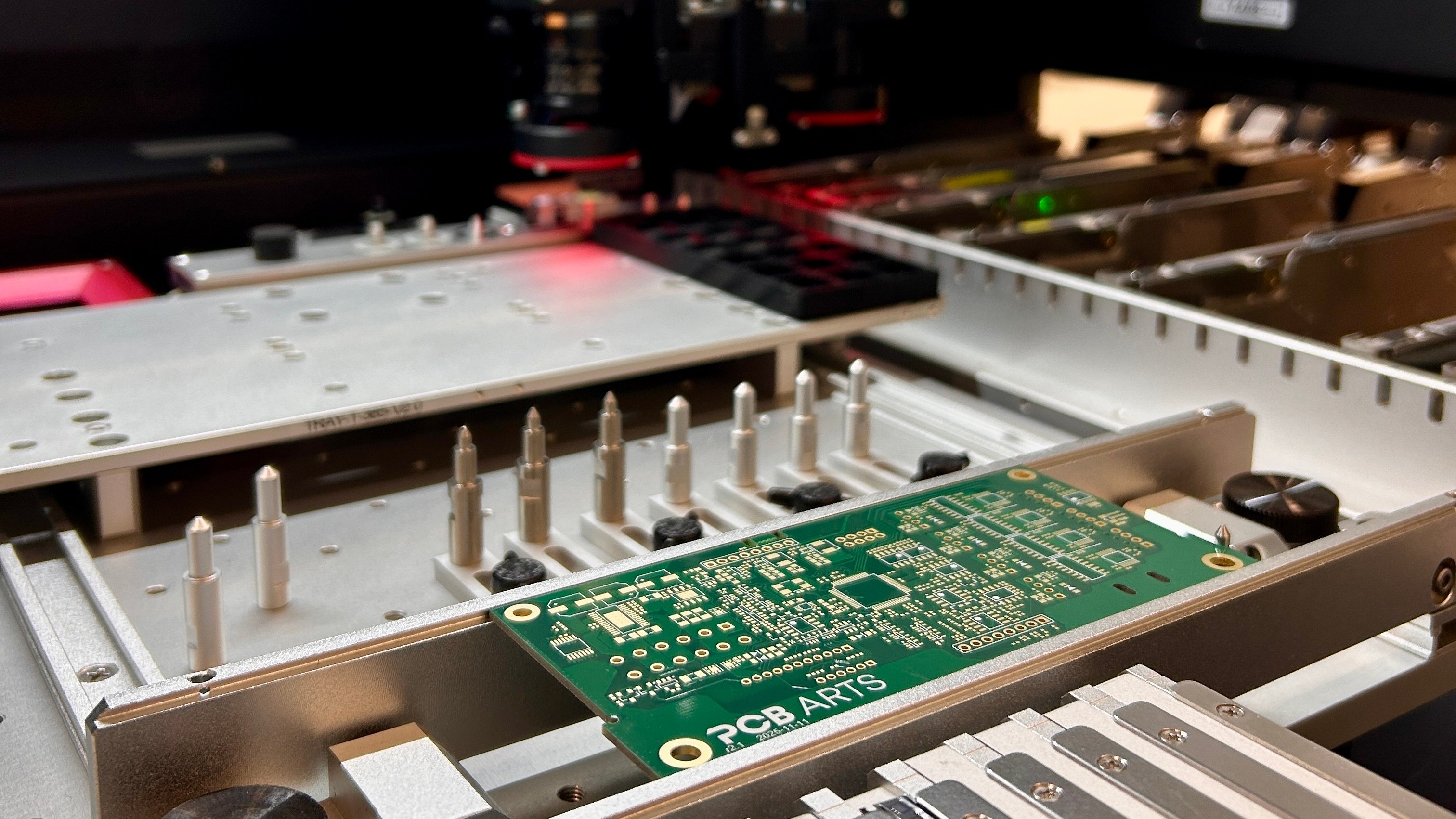
We run our pick-and-place machine exclusively for PCB Arts projects and products – no external EMS service. Here's what's surprised me most in the first months of operation.
Key learnings
Component management is a much bigger topic than I expected. Keeping track of which parts are where, what's open, what's committed, what needs to be reordered – and doing it systematically – turns out to be central. Both to keep the overview, and to run the process efficiently.
80 % of the time goes into setup. The placement itself is a fraction: the machine places 400–500 components on a board in 10 minutes. Loading the right reels into the right feeders, calibrating pick positions, verifying parts – that's where the hours go.
The machine has no intelligence. A modern pick-and-place is mechanically and optically extraordinary, but it has effectively no AI. In my view, there's a clear technology gap especially in the teach-in of pick positions, compared to what's possible today with edge vision. That has made the relevance of our own edge technology more concrete to me than any whitepaper could.
Why setup costs barely apply to us
A typical EMS provider faces a new setup with every job – different feeder layouts, different parts, different programs. Because we only build our own products, the same reels stay loaded and the same programs sit ready. The 80 % setup overhead largely disappears in serial production. That's also why we don't open the line to external work: it would erase exactly that advantage.
My takeaway
The PnP is a major value gain for us, especially when you see boards with around 1,000 components, many of them 0402 and fine-pitch, populated with ease. That's when the potential of the machine really lands.
We've now completed our first complex production runs at industrial-level quality. The learning curve has been steep, and it will stay steep until we have a fully consolidated process for running small series efficiently and reliably.